





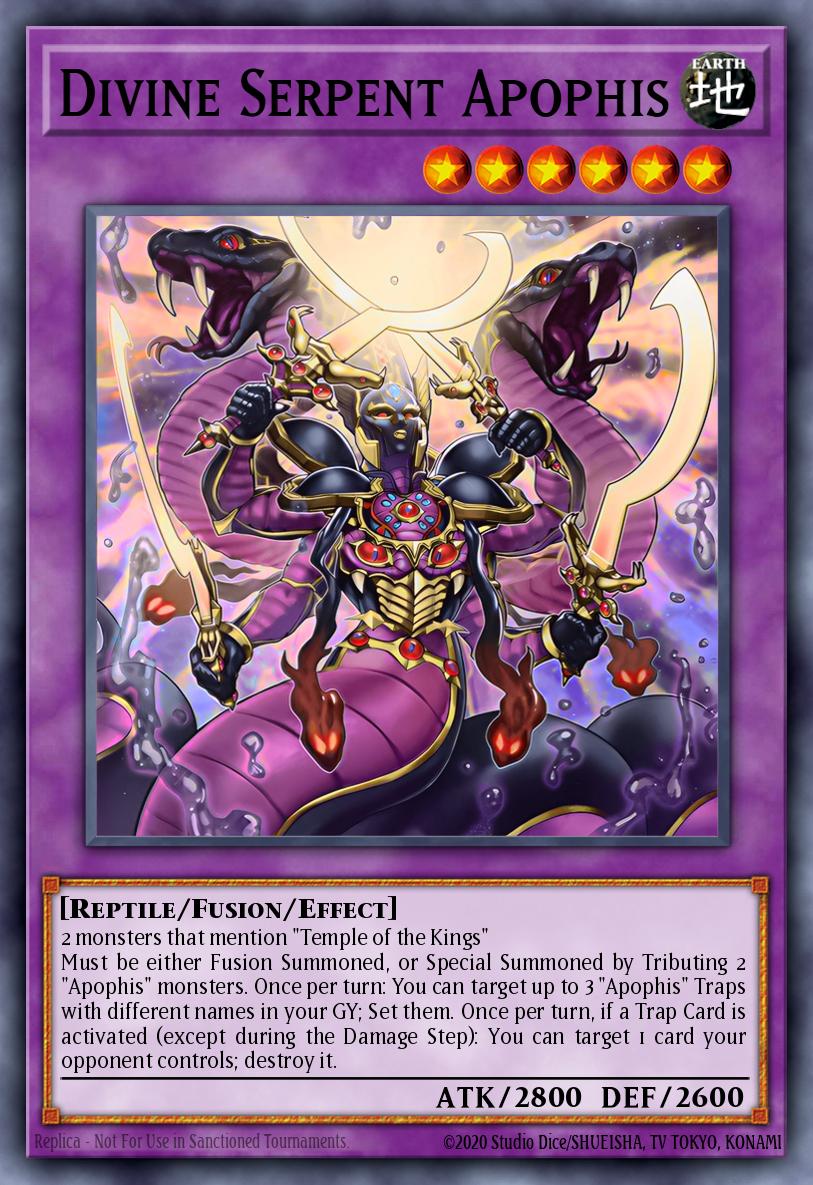

 EARTH
 6
Divine Serpent Apophis
Archetype:
Apophis
ATK:
2800
DEF:
2600
View:
628
2 monsters that mention "Temple of the Kings" Must be either Fusion Summoned, or Special Summoned by Tributing 2 "Apophis" monsters. Once per turn: You can target up to 3 "Apophis" Traps with different names in your GY; Set them. Once per turn, if a Trap Card is activated (except during the Damage Step): You can target 1 card your opponent controls; destroy it.
Divine Serpent Apophis — Power Evaluation
Final Score: 53 ± 8 · Confidence: Medium
- Intrinsic: 54 · Deck: 56 · Meta: provisional
- Primary role: Removal / Negation · Secondary: Recovery/Recursion
Why it scores here
The card's value is its once-per-turn trigger: each Trap activation (any player's, per the text) lets it destroy one opponent card, and it can set up to 3 different-named Apophis Traps from the GY each turn. That is real interaction plus trap recursion, which earns the Removal and Recovery weights. The 2800 ATK and the Fusion frame earn nothing, and the Fusion or tribute-2-Apophis summon requirement holds the accessibility and deckbuilding axes down. No combo data was supplied, so the combo axis rests on text alone.
Axis scores
| Axis | Score | Evidence |
|---|---|---|
| Accessibility | 50 | The summon needs Fusion Summoning or tributing 2 Apophis monsters, but it appears in 400/400 sampled decks at about 2 copies each (verified, observed). |
| Combo & Conversion | 45 | Destroying one card per Trap activation and resetting traps from the GY is a text-level conversion with no recorded board or power index support (inferred). |
| Resource Economy | 60 | Setting up to 3 Traps from the GY recovers spent resources and the destroy is a 1-for-0 when triggered (verified, inferred). |
| Effect & Interaction | 65 | A once-per-turn destroy on any Trap activation is strong, but it depends on a trap actually being activated (verified, inferred). |
| Material Utility | 25 | Its Fusion frame and archetype-locked summon make it a weak generic material, with no material data supplied (inferred). |
| Resilience & Flexibility | 45 | The effect is once per turn and easily negated, but up to 3 copies and multi-turn trap resets add some redundancy (verified, inferred). |
| Deck-Building Efficiency | 40 | The Apophis-only summon requirement and archetype dependence make it a restrictive slot, although 2 copies per deck is a modest commitment (verified, observed). |
Calculation
Weight profile: 0.7 Removal / Negation + 0.3 Recovery/Recursion. Intrinsic ≈ 54, Deck ≈ 56, Meta = provisional. Modifiers: Self-locking summon restriction (-2). Final formula: 0.40*Intrinsic + 0.60*Deck, then -2 modifier
Strengths
- Once-per-turn destroy on any Trap activation, which covers both players' traps
- Recovers up to 3 Apophis Traps from the GY each turn
- Present in 400/400 sampled decks, showing it is reliably included in its homes
Weaknesses
- Requires a Trap activation to trigger its destroy
- Once-per-turn limit on both effects
- Fusion or tribute-2-Apophis summon restriction
Counters / choke points
- Negating its effect (speculation: depends on the opponent's interaction)
- Removing or banishing it before a Trap activation occurs (inferred from the trigger condition)
Best use
Trap-based removal and recursion engine in Apophis decks. Decks: Apophis, Temple of the Kings, Odion. Suggested copies: 2.
Evidence & gaps
- Verified: Destroys 1 opponent card once per turn when any Trap Card is activated (except during the Damage Step); Sets up to 3 different-named Apophis Traps from the GY once per turn; Summon requires Fusion Summoning or tributing 2 Apophis monsters; Present in 400/400 sampled decks at 2.02 average copies
- Observed: Inclusion of 58% in Apophis and 50% in Temple of the Kings (usage statistics); Top partners include Apophis the Serpent and Apophis the Swamp Deity at 99.8%
- Inferred: Its removal is conditional on trap activations and is a 1-for-0 when triggered; Trap recursion provides resource recovery and redundancy
- Data gaps: no combos supplied, so combo conversion and starter/material roles are text-only inference no guides supplied no rulings supplied for trap-activation timing and chain interactions no banlist token; assumed 3 copies (unlimited)